FollowTheBaldie.com

Tag: Barcelona

  • Video in Spanish by foreign language students warning against street crime in Barcelona

    I thought the reënactments in the second half were rather good. One of the commenters, however, mistook the medium for the message and was seized by an attack of lust.

    (Via Robbed in Barcelona. Here’s one I managed to photograph, in Vilafranca del Penedès.)

  • Introducing the Gaudí Experience theme park

    I haven’t been up to Park Güell for a couple of months, so I guess this is about Gestmusic Endemol (ex La Trinca) reinventing the office space they have up there – the gym where Pare Jacint Alegre meets Molist used to be used for Operación Triunfo, but tastes change, and who are we to object.

    Anyway, the good news gleaned from the trailer is that this mini-attraction will recreate Gaudí’s construction techniques as well as giving us an insight into his extraordinarily liberal musical tastes:

    All together now:

    Money was my first love
    and it will be my last.
    Money in the future
    and money in the past.

    (H/t DE)

  • Announcing a 9-day tour of northern Spain’s industrial heritage in September 2012

    Guides Mr Douet and Ms Criado on this expedition will have different stories, but for Mr Baldie this all started at primary school when Mr Bigley (bicycle, brilliantine, brilliant), tiring of 35 bawling sopranos and a rather miserable classroom, reinvented himself as an urban William Cobbett, and started walking us round the neighbourhood. We inspected late- and post-Victorian houses and churches, workshops and factories, encouraging us to think about our future as well as improving our general education – two of the largest local employers, the docks and the car plant, were then in terminal decline.

    The cake department at the bread factory stuck in my mind, but musical diversions meant that – apart from some minor incursions with works bands in Lancashire – I didn’t get to meet big machines with numerate owners again until some 15 years later, when I did more or less useful stuff for several American-owned textile businesses in Germany. This was followed by a Dutch industrial and utility power generation manufacturer, and then finally a software startup which ran scheduling and supply chain operations for manufacturers like Heineken and parts of Unilever and GlaxoSmithKline. (It is said that Eastman Kodak at Rochester, NY still recalls a (successful) sales presentation on how our package would enable rapid restructuring of their US business in the face of a Martian invasion.)

    In a wonderful letter to his friend Maurice Delage, the composer Ravel describes one of the great discoveries of his 1905 voyage up the Rhine:

    After a lazy day on a very wide river between hopelessly flat banks devoid of character, we came upon a city of chimneys and domes spewing forth flames as well as reddish and blue fumes. It was Ahaus [sic], a gigantic foundry in which 24,000 men work night and day…. We went down to the mills at nightfall. How can I tell you about these smelting castles, these incandescent cathedrals, and the wonderful symphony of travelling belts, whistles, and terrific hammerblows which envelop you? And everywhere the sky is a scorching, deep red. Then, a storm broke out. We returned horribly drenched, in different moods. Ida [Godebska] was terrified and wanted to cry. So did I, but for joy. How much music there is in all of this! – and I certainly intend to use it. (Arbie Orenstein (ed), A Ravel Reader: Correspondence, Articles, Interviews)

    I’m not smart enough to survive unscathed for very long in a world dominated by the exact sciences, so my clumsy incursions into science and technology have always been accompanied by cultural excursions of this type. I’d read the steamier bits of Zola as a kid, but a serious addiction to Victorian-era industrial naturalism/realism came while struggling (almost suicidally) through the Silesian dialect version of Hauptmann’s De Waber, a bleak tragedy based on an 1844 weavers’ rising. Then came more Nordics, the French, and the Spanish – my favourite, Baroja, and writers like Pérez Galdós, Pardo Bazán, Valle-Inclán, Blasco Ibáñez, Oller, Vallmitjana…

    These two personal streams meet here in what the Germans call Industriekultur, roughly translatable as industrial heritage. This, without ending up as a witless mishmash, seeks to provide a broader context for industrial archaeology: the history of science and technology is related to that of entrepreneurs, finance and labour, of geographical and architectural space, and so forth.

    We have chosen to focus on the Bourbon restoration in Spain, which inaugurated a long period of comparative peace, facilitating a great, overdue, and short-lived qualitative and quantitative leap in industrialisation, and a great burst of creativity in which Gaudí is the best-known of many names.

    And the two products we earnestly hope to flog to you are:

    1. A splendid 9-day tour of northern Spain’s industrial heritage, first scheduled for this September.
    2. A specially published bedtime reader containing freshly translated excerpts from contemporary novels, diaries, industry journals and reports. This is free if you sign up for the tour, and will otherwise be available via the usual online outlets. The model for this is Humphrey Jennings’s brilliant Pandaemonium: The Coming of the Machine as Seen by Contemporary Observers, 1660-1886 (NYT review), although my selections may reflect a slightly less pessimistic view of progress…

    We look forward to meeting as many of you as possible, and, although we’ll be informing via channels like the AIA (here’s the piece from their February newsletter), please do spread the word!

    [

    Bonus

    Ravel attempted to use his Ruhr experience in an opera, La cloche engloutie, “The sunken clock,” based on Hauptmann’s Die versunkene Glocke, but abandoned the project, although he apparently reused some of the material in his Spanish clock opera, L’heure espagnole. Here’s the Glyndebourne version:

    ]

  • A ruined textile workshop on the banks of the Llobregat

    A macabre pleasure of the Llobregat valley over the past few years has being able to walk into the factories and workshops of this once great manufacturing zone as they close. The non-fixed assets are worthless, industrial space is not exactly at a premium, so why bother with human or canine vigilantes?

    Officially on a variant of this Montserrat walk, we found time to have a look at Acuabase SA of Olesa, which provided processing and finishing services to textile manufacturers in Manresa, Igualada, Terrassa, Esparraguera etc until the money ran out in, I think, summer 2009.

    The interior is Marie Celeste sacked by the Goths. Athough the youth have clearly looked in, the gypsy rag traders and African metal detectors have yet to arrive, and so a collection was made of sample and pattern books, and several rolls of cloth were acquired for informal export. The chemicals were left to their own devices, and the boiler was simply too heavy. A substantial number of “Made in Italy” finished garments was a reminder of the large-scale and continuing fraud in denominations of origin for a variety of goods, of which olive oil (“Italy” = Spain, Greece, Turkey etc) is the best-known.

    The guy who should have been taking the photos is Ferran Giménez, who, working out of a studio in Sants, Barcelona, has captured urban decay in Spain far better than anyone else I know of.
    Error: the communication with Picasa Web Albums didn’t go as expected. Here’s what Picasa Web Albums said:


    Error 404 (Not Found)!!1

    404. That’s an error.

    The requested URL /data/feed/api/user/111257672258796628424/album/AcuabaseSAOlesaDeMontserrat?kind=photo was not found on this server. That’s all we know.

  • Pisa bar fined €1000 for charging Spanish tourist €26 for 3 * (coffee + brioche)

    Here. Apparently the barman thought the guy was from Barcelona and wanted to make him feel at home. Why on earth was crucifixion along the Appian Way abolished?

  • Free self-guided walk from Barcelona airport to Barcelona

    Here. This is one of my favourites and works perfectly well as it is, but an even more interesting, guided walk is available here.

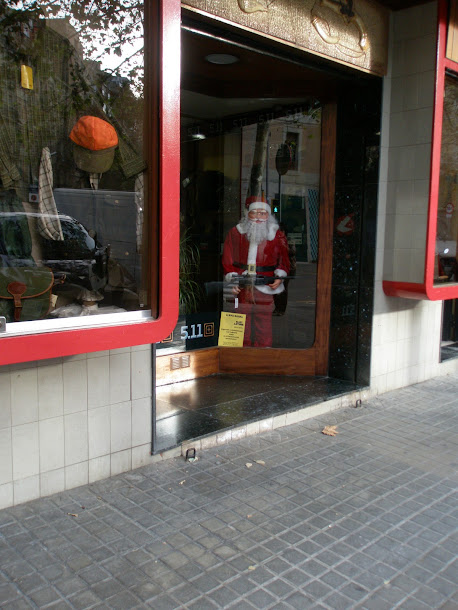
  • Bad Santa vigilante hits crime-ridden Barcelona

    In c/ Parlament. Ms Santamaria (geddit) gasped in alarm, but Santa didn’t blink.

    CC for commercial use by MJS. More.

  • But is that acorn-fed Iberian black pig or shoe leather you’re chomping?

    Christmas time is ham time. It’s also a time when, knowing that some of you may have had one or two bottles too many, some tapas bars and restaurants will flog you cheap ham as something rather better – cat for hare, as the Spanish say. In the run up to Christmas last year the Andalusian agriculture councillor announced that there was twice as much local jamón ibérico product on sale as there was local production, and that she had just seized 17 tonnes of fakes. (There was a lovely cartoon in El Jueves: a civil servant asks whether an Iberian pig has four legs; yes, says his colleague; we’re producing for eight, says the first.) Massive shipments of similar-looking product from far cheaper markets like Hungary, certificated where appropriate by corrupt Protected Geographical Status administrators, provided high-status dainties for all at lower prices than you would have expected given factors like the construction bubble and the shortage of reliable and affordable swineherds.

    Various techniques have been used to try to halt this and similar fatty frauds (check the Olive Oil Gazette re the resale of cheap oils as mamma‘s favourite Italian premium brand). Chemical approaches – chromatography was the classic – looked for typical compounds, but evasion was pretty simple. Physical methods – infrared spectroscopy is popular (check this wonderful article about the application of artificial neural networks to pig carcase analysis) – will presumably also be defeated at some stage, given that acorn-fed ham from Iberian black pigs can go for 6-7 times as much as Spanish-produced, white pig jamón serrano. And you’re quite unlikely to be carrying an appropriate hand-held spectrometers as you head down Barcelona’s Ramblas. Finally, as far as I know, despite DO regulations specifying admissible racial mixes (here are the Extremaduran rules) and vague EU noises about traceability, the first DNA-certified ham was only marketed in 2010 – a Maldonado “Albarracena” at €1,500, and if you manage to acquire one then do let me show you how to cut it.

    So the best advice is probably not to pay good money for something that looks crap, and not to give up if you get fed a couple of duds along the way. If that doesn’t sound like particularly good news for you, then there may at least be a brighter future in store for your snack. While the Maldonado super-porkers had up to 10 hectares of dehesa each, the Royal Decree 1469/2007 approving quality standards for Iberian pig meat, ham, palette and loin determines that you can cram two pigs into each hectare, and that this will ensure access for all to the tree-full of acorns required on average to generate each extra kilo of flesh. However, a splendid recent article by Vicente Rodríguez-Estévez, Manuel Sánchez-Rodríguez, Antón García and A. Gustavo Gómez-Castro, Feed conversion rate and estimated energy balance of free grazing Iberian pigs, makes a convincing case that each pig should get a double that – one hectare – rather as every Englishman has his metaphorical castle.

    [
    Want to cure your own pig, or export phoney Chinese meat products to Shanghai? The FAO has some fascinating general info.
    ]

  • How María Isabel Cuellar fixed her defective tortillas

    Vote is from the Latin votum, a vow, a wish, a prayer, generally involving a deity. However this morning’s stroll didn’t involve voting for old bearded men in Spain’s general elections, but inspection objects whose name comes from the same root, votives:

    In the Roman Catholic Church offerings were made either to fulfill a vow made to God for deliverance, or a thing left to a Church in gratitude for some favor that was granted. Today votives can be lit votive candles, offered flowers, statues, vestments, and, monetary donations. Traditional special forms of votive offering ex votos include small silver models of the afflicted part of the body, inscribed stone tablets, folk art paintings of an incident of danger such as the votive paintings of Mexico, and model ships donated by sailors who have survived a dangerous voyage. Many Catholic churches still have areas where such offerings are displayed.

    The hilltop sanctuary we visited today is close to the old port of Premià de Mar, which was involved in a small way in the Cuban trade, and so there’s a nice little collection of 19th century maritime paintings of terrible storms and shipwrecks, with the Virgin popping out of the sky in the nick of time.

    However, it also has the usual contemporary collection of crutches, stuffed toys and L-plates, left in gratitude for minor cases of divine intervention, such as we also find walking up Montserrat and in a great number of other places, including this Gracia walk, this Girona country tour, and on tombs in the great Montjuïc cemetery. (But if you’re leaving things, you have to be careful: a friend who decided to stop being a boring lawyer and become a super-gendarme, with modern weaponry and a fast car, on graduating from police academy and receiving a proper uniform had to leave her trainee cap well concealed in her granny’s niche (is that ancestor worship?) to avoid attracting the wrath of naughty neighbours.)

    However today I wanted to share a wonderful example of casual solidarity with the deity from the great city of Guanajuato, Mexico, in which one Maria Isabel Cuellar explains how her manky (< the equally non-standard chueco) tortillas were cured, mending her relationship with her mother, and how she showed her thanks. It’s here, as part of the Wellcome Collection’s brilliant London exhibition of Mexican ex-votos, which I hope will outlive online its physical sell-by date.

    Inevitably there’s been a great amount of modern reworking of votive offerings, which I may get round to blogging some day here or here.

  • Look for a good guide, not an official one

    We regularly receive anonymous emails in Spanish, Catalan, and bad English threatening dreadful consequences unless we either stop all this fare il cicerone nonsense or waste huge amounts of time and money obtaining offical guide diplomas and then make annual payments to official guide guilds. Since this may be a matter of interest or concern to customers, as well as to emotionally disturbed losers, I have attempted to clarify the question in FAQs, suggesting that such menaces betray either extreme ignorance or a hankering after dictatorship. Here, though, is some rather more entertaining rubbish.

    18th & 19th centuries: laissez-faire tourism

    Henry Swinburne is probably as much to blame as anyone for converting Spain into an annex of the Grand Tour and thence into an obligatory destination for witless drunks who enjoy the smell of their own flesh burning. In his Travels through Spain, 1775 and 1776 he writes of local tour guides that

    One of the greatest vexations a curious person experiences in travelling through Spain, is the scarcity, the non-existence of tolerable Ciceroni; those you meet with are generally coblers, who throw a brown cloak over their ragged apparel, and conduct you to a church or two, where they cannot give you the least satisfactory information concerning its antiquities or curiosities. This is literally the case at Toledo: but to make amends, they lead you to a hole in a pillar, where the host was hidden all the time that the Saracens were in possession of the city, though the whole fabric has been built from the ground since the expulsion of the Moors; for Saint Ferdinand laid the first stone of the present church in 1226. They also shew you the stone on which the Virgin Mary stood, when she came to pay a visit to Saint Ildephonsus, and which is worn through by the fingers of the pilgrims. Ask them any thing about the Mosarabic chapel, and what is done there, they will tell you, as they did us, that mass is said there in Greek.

    Washington Irving had been and gone, the market grew, and in late 1840s Granada William George Clark (Gazpacho: or Summer months in Spain (1850)) witnessed the following battle between the son of Irving’s guide, a monolingual “son of the Alhambra,” whose “family had lived in the fortress … ever since the conquest …, old Christians, without any taint of Moor or Jew”, and his principal competitor, a polyglot Jewish renegade:

    As we were all waiting in the diligence-bureau, till the custom-house officer had gone through the ceremony of unlocking and locking the trunks, I was accosted by a dapper young fellow in Andalucian costume: ‘Señor! your worship is a stranger?–an Englishman? Ah, I knew it! Milor, (these laquais-de-place think that every Englishman likes to be so addressed, and they are right,) I am at your feet–I am Mateo Ximenez, son of old Mateo–honest Mateo, the Mateo of Vasindon Eerveen, the son of the Alhambra, who will show you every stone in Granada.’ On the other side, an elderly person introduced himself as Señor Vigarai, landlord of the adjacent hotel, where he entreated me to stay, vaunting its superior cheapness, &c. But as I prefer being fed for two dollars per diem to being poisoned for one, I shook off the touting landlord, (a character very rare in Spain,) and trudged off to the Fonda de Minerva, closely followed by the officious Mateo. I was shown to a spacious apartment on the first floor, where I proceeded to instal myself, Mateo aiding unbidden.

    We had not been there five minutes before a dark, keen-eyed man, with a fierce moustache, appeared at the open door, cap in hand, and addressed me in English–‘Good bye, Sare! how you do? I am Immanuel Bensaken, of Gibraltar, British-born; much commended in dat red book you wear in your hand, page 129,–Give me leave, Sare?’ He proceeded to find the place, but Mateo, high in wrath, broke in with a torrent of vituperation, speaking Spanish, the substance of which seemed to be that I belonged to the Ximenez family by right of prior discovery. Bensaken, on the other hand, claimed me by right of conquest, because the English were masters of Gibraltar. ‘Milor,’ said Mateo to me, in a tone of solemn warning, ‘this man is a Jew, a thief, a runaway, a renegade Jew.’

    Bensaken, upon this, assured me that old Mateo had helped one of his sons to murder a man, holding him down while the son despatched him with a knife. The dispute lasted some time, and I was at last obliged to request the two to fight it out in the corral below, promising myself as the prize of the survivor.

    By then Emanuel Bensaken had already worked for Owen Jones and made his literary debut in Richard Ford’s A handbook for travellers in Spain (1845), and was to appear regularly in subsequent English Andalusian travlit–see for example GA Hoskins’ Spain, as it is (1852), AC Andros’ Pen and pencil sketches of a holiday scamper in Spain (1860), Matilda Betham-Edwards’ Through Spain to the Sahara (1868), Henry Blackburn Travelling in Spain in the present day (1869).

    The cut-throat rivalry between this intruding guide clan and the home-grown Jiménez has much of Exodus about it–glib cosmopolite Aaron/Blair bitterly resented by grim thoughtful Moses/Brown–to which is added wariness of Jewboys, anglocabrones, and such. And there we have the intellectual basis for present-day tourist guide legislation and practice. But I’m getting ahead of myself.

    Alfonso XII to Azaña: cautious promotion, little regulation

    Granada was probably Spain’s principal tourist attraction in the late 19th century, and Mr Cádiz tells me that Granada’s local authorities were the first in Spain to try to restrict market access for allochthonous guides, somewhere in the 1870s. However, market growth on the whole was so slow that central state intervention when it came aimed to stimulate rather than regulate, and Carmelo Pellejero Martínez writes in “La política turística en España. Una perspectiva histórica” that growth remained the sole objective of national tourism policy from its inception under the monarchy in 1905 through the dictatorship of Primo de Rivera until the end of the Second Republic.

    And so the first notable tourist guide legislation, the Royal Decree of 25 April 1928 (which Mr Cadiz says was copied from the French), aiming to maximise the benefits of the upcoming Barcelona and Seville Expositions, creates the Patronato Nacional de Turismo and envisages a role for state-recognised tourist guides, “Qualified persons with advanced command of foreign languages and with adequate artistic culture to serve as guides for tourists.” But there seems to have been no attempt to define or exclude unsuitable persons, and, while in 1929 a formal legal distinction was made between Local, Island, Provincial and National Guides, what with monarchic paralysis and republican chaos nothing much seems to have happened.

    And then came Franco and official guides, and a legacy of paranoid and interested interventionism which may well outlive the European Union.