FollowTheBaldie.com

Tag: Barcelona

  • The physical invention of historical Barcelona

    Here’s an excellent piece by Agustín Cócola Gant on the creation in the mid-20th century of Barcelona’s so-called Barrio Gótico by Catalan nationalist entrepreneurs: a Disneyland avant la lettre to erase the memory of 400-odd years of failure following the city’s eclipse by Valencia, and serve as a marketable brand for plebeian Grand Tour-ism.

    At the end he fails to land a punch on capitalism – socialists, Shahs and sundry indulged in even more shameless themeparkisation, and no other economic system has produced serious history of comparable quality or quantity – but he makes the interesting suggestion (without mentioning Umberto Eco’s splendid and seminal Travels in hyperreality!) that, like the Americans, we should acknowledge to punters that the palaces, synagogues, etc etc are 20th century fantasies, and that they will be pay for this.

    That strikes me as bit unworldy – like Donald Rumsfeld, he doesn’t appreciate that for the happy snapper, which is just about everyone, brand Old Europe is all Europe – and it runs against our experience taking folks around.

    I virtually never do the “old town” for the same reason I don’t go to EuroDisney or Venice – boring buildings, boring people – but evolved standard practice is to figure out how smart clients are by throwing them post-modern bait of some nature.

    If they bite – which is by no means that often – then you can deliver a happier pitch: you pretend it’s not a film set, and the group pretends to believe you.

    Only in about 5% of cases – so not those who buy the Glorious Medieval Past, nor those who believe copycat silliness like the Glorious Anarchist Past or the Glorious Second Republic, etc etc – does it make any sense to get cultural-critical. And I’m not sure all that cynicism is all that much fun either.

    So, from the horse’s mouth, a big nay.
  • Arturo Pérez-Reverte: build shit, attract shit

    APR is one of Spain’s best-known novelists, and a blustering columnist to boot. Here, translated by Lenox Napier, is a tourism rant of his which is getting a lot of attention at the moment:

    We forget that for decades we have been clamoring for this exact kind of tourism and how we were prepared to trash our coastal villages to benefit from their miserable crumbs, building endless outdoor bars, welcoming anything without the least aesthetic appearance or good taste, scrapping traditional business, turning our children into snack bar waiters to lick the shoes of the drunkest and most worthless tourists in Europe.

    And so on.

    Blaming Johnny Foreigner is all very well – APR’s anti-nationalism is only skin-deep – but the wanton, comprehensive destruction of the Mediterranean littoral also served perceptions of domestic demand. In January 2005 I cycled south from Barcelona to Valencia, and then cross-country to Cádiz for Carnival. Even then, before the final, mad surge of the construction boom, the journey along the coast through the provinces of Barcelona, Tarragona, Castellón and Valencia recalled the obliterating, levelling, stultifying megalomania of Ceausescu’s architectural project for Bucharest and Romania, but the hoardings for the rabbit hutches in construction were in Spanish, not English or German. The Spanish are also incredibly fond of cheap seaside apartments and are increasingly ferocious drinkers and brawlers, but perhaps APR decided they wouldn’t retweet that information.

    I suppose comfort may be sought in the fact that the rest of the Mediterranean is rapidly catching up in terms of the destruction of cultural environments – Russian ribbon development along the Ancient Greeks’ beloved coast of Pontus is said to be quite spectacularly … Russian – and so the relative economic disadvantage may be minor. So perhaps we should just stay away for a decade – for all the human curiosities encountered, I wouldn’t repeat that journey – and wait for Al Gore’s new Zanclean Deluge to sweep it all away. Al? Al?! Where’s a man when you need him?

  • Walking from Barcelona to Madrid

    Some of Barcelona‘s Plaza de Cataluña 15M indignados have set out on foot for Madrid, accompanied by Walter and his version of the Rinky-Dink Mobile Bicycle-Powered Sound System. Their aim is to arrive at the Puerta del Sol in time for a demonstration on July 23, and their route plan suggests that they’re planning to achieve this by walking 545 km in 29 days. Google Maps says it’s rather more, at 614 km, but whether their daily average is 18.79 or 21.17 km, with no days off there’ll be some sore heads and feet on those unshaded roads now that temperatures are projected to reach 40ºC.

    The Puerta del Sol is of course the traditional lair of the Spanish postal dragon, whence official routes were imagined in 1720 and distances officially measured starting in 1857. All these radial marches converging on it have done nothing to calm the Bourbonoias of Catalan nationalists, who already saw the predominance of Spanish, Barcelona’s lingua franca, in the Barcelona protest as evidence of a centralist plot, forgetting that Catalan only prevails in what they like to call “civil society” because participation is contingent on subsidies and subsidies are contingent on linguistic practice.

    These fears should (but probably won’t) be mollified by the fact that, rather than following the imperial post routes, which averted encounters with highwaymen, hunger and the nastier bits of nature, the marchers are taking a short cut across Lower Aragon. 200 years ago, according to Bernardo Espinalt y García’s Dirección general de cartas en forma de diccionario: para escribir a todas las ciudades… de toda España para mayor facilidad del comercio, y correspondencia pública de sus naturales y estrangeros (1835), their return journey would have looked like this:

    to…

    Spanish leagues
    Torrejón de Ardoz

    4.0
    Venta de Meco

    3.5
    Guadalajara

    3.5
    Torija

    3.0
    Gajanejos

    3.0
    Almadrones

    2.5
    Torremocha

    3.0
    Bujarrabal

    2.5
    Lodares

    2.5
    Arcos de Jalón

    2.5
    Monreal de Ariza

    3.0
    Cetina

    2.0
    Bubierca

    2.0
    Ateca

    2.0
    Calatayud

    2.0
    El Frasno

    3.0
    La Almunia de Doña Godina

    3.0
    La Romera

    3.0
    Muela

    2.0
    Garrapinillos

    2.0
    Zaragoza

    2.0
    La Puebla de Alfindén

    3.0
    Osera de Ebro

    3.0
    Venta de Santa Lucia

    3.0
    Bujaraloz

    3.0
    Candasnos

    3.0
    Venta de Banrs (?)

    2.0
    Fraga

    2.0
    Alcarràs

    3.0
    Lleida

    2.0
    Bell-Lloc d’Urgell

    2.5
    Golmés

    2.5
    Vilagrassa

    2.5
    Cervera

    2.5
    La Panadella

    2.5
    Gancho (? Ganxo/Gantxo)

    2.5
    Igualada

    2.0
    Castellolí

    2.5
    Collbató

    2.5
    Martorell

    2.0
    Sant Feliu de Llobregat

    3.0
    Barcelona

    2.0
    total

    109.0

    Such routes are of course far older than Philip V or postmen – see for example Pedro Juan Villuga’s 1546 compilation, where the centre of gravity is Toledo, the old capital. Assuming we’re measuring using the legua real (Spanish metrology was quite chaotic until quite recently), Espinalt y García’s version would have taken a whopping 728.88 km, but his long and cranky predecessor of the modern, straightened motorway would at least have given marchers the opportunity to attempt to proselytise a doubting public in bars along the way – wasn’t that what the Jarrow Crusade was all about? Instead, rather like modern politicians in need of democratic renewal, they will travel with a support team through the arenous wastes of Teruel and Guadalajara, and we will have to learn of their progress and pronouncements from TV and internet broadcasts.

    That rather lonely set-up worries me: could it be that what they have in mind is the mythologised unifying function of Mao’s not-so Long March into desolation in the creation of the Chineses dictatorship, or some other foreign folly, rather than great Spanish pilgrimages of our somewhat over-extended late-medieval age? Ah! for the march from Málaga to Madrid in 1982 of 30 blind lottery ticket vendors unhappy with their contractual arrangements, all of whom survived, or the departure in June 1533 for Montserrat of more than 2,000 citizens of Barcelona, many forswearing footwear, by which they hoped to cure the wife of Charles I of Spain of a dreadful case of toothache.

  • Heron City, Meridiana, Barcelona to Cerdanyola on foot

    Since someone asked, here’s what I can remember. Walking time probably 2.5 hours. Your money back if you die of hunger or are eaten by wolves.

    Head to Roquetes more or less via Via Julia metro (couple of excellent bars in the pedestrian street leading up to it), walk to the top of the shantytown and then up over open ground (there are a couple of paths and staircases) to the junction of Carretera Alta de Roquetes and Carrer Lliçà (tower of Torre Baró and ugly mirador to your right).

    If you want to take a detour to the high part of the shanties of Torre Baró with a couple of interesting bars and curious folk with the occasional pig and chicken, walk about 80m down Lliçà and there’s a break in the crash barrier with a path leading through the pine forest.

    Otherwise to continue Cerdanyola-wards take the stone path that bisects Lliçà and Alta de Roquetes heading uphill. I think you then take the 2nd path on the left, which takes you in about 10 minutes up to the summit with splendid views over Barcelona and the Maresma. You then follow the ridge for about 5 minutes, passing on the right an old iron mineshaft on the right and a path back to an old research station on the summit. [Walk tour that includes this bit.]

    In a clearing with a couple of Italian stone pines a path to the right (I think it’s signposted Can Cuyas or perhaps Sta Maria de Moncada) takes you down from the ridge. You’ll pass the cemetery on your left and then I think you arrive at a bridge over the motorway with the industrial zone of Can Cuyas on your right.

    Don’t cross the bridge unless you want to go via Sta Maria, but drop down into the valley on your left with allotments and a compound containing the flock used to graze that end of the forest. Walking parallel to the motorway along a winding dirt track you get to the cemetery access road. Turn left on that and then I seem to recall a path (lots of paths) through the woods to get to Cerdanyola.

    Here’s an approximation to the first part:


    View Larger Map

  • Church of Sant Pau at Montmany about to fall down?

    That’s the claim here, although I have to say it doesn’t seem to have got much worse in the years I’ve been basing a route around it. Partial collapse, leaving accessible Gothic-ish ruins, might even be preferable, but if it disappeared completely and the mad, mad farm next door were to be civilised then the walk would lose much of its eccentric charm.

  • Barcelona bike rentals – comparative chart

    Since folks started offering bicycle tours and rentals to tourists a few years back, quite a lot of businesses have come onto the market and there’s been something of a price war. So I thought it would be interesting to compile a brief guide to who charges what. Barceloneta Bikes almost always make good on their “best hire rates in the city,” although I have no idea what kind of bikes they use. I’m a big fan of Classic Bikes‘ mid-priced models. And given their prices My Beautiful Parking must be doing something else that is really special to get any business at all. Some of them are vague on opening hours, and a couple on whether a day means 24 hours or not. Anyway, here you are.

  • Time to introduce urban hunting in Barcelona?

    There’s a lovely bit in Isaiah 13 describing the ruin and desolation of Babylon:

    And Babylon, the glory of kingdoms, the beauty of the Chaldees’ excellency, shall be as when God overthrew Sodom and Gomorrah.
    It shall never be inhabited, neither shall it be dwelt in from generation to generation: neither shall the Arabian pitch tent there; neither shall the shepherds make their fold there.
    But wild beasts of the desert shall lie there; and their houses shall be full of doleful creatures; and owls shall dwell there, and satyrs shall dance there.
    And the wild beasts of the islands shall cry in their desolate houses, and dragons in their pleasant palaces: and her time is near to come, and her days shall not be prolonged.

    Lieutenant James Graydon RN, George Borrow’s colleague in these parts, obviously didn’t sell enough Bibles in the vernacular, because it doesn’t seem to have occurred to witnesses of the following incursion by a sounder (not a family) of boars from this walk on the Collserola hills behind Barcelona to this Gracia walk, near Plaza Lesseps, presumably making use of the 2-mile on-the-way-to-being-a-green-corridor created by Park Güell, Monte Carmelo and the Creueta del Coll, to draw a parallel between Babylon and Barcelona:

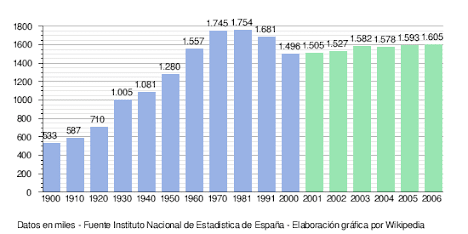
    Unfortunately for opposition parties of a Christian bent fighting the regional elections in November, the increasing presence of ex-wild beasts in Barcelona has been accompanied by a slight rise, rather than a dramatic fall, in population:

    The doleful creatures, satyrs, and dragons in pleasant palaces might be considered a fair reflection of Mayors Hereu and Clos’ troubled reign, were this problem not common to many Western cities. In a piece in the FT during the great London fox hoohaa in June Frederick Studemann issued a bold call for the introduction of urban hunts, on foot if need be:

    For the Conservative-Liberal Democrat coalition, the urban hunt would be a vehicle for the localism, the grass-roots engagement, that both parties are so keen to animate. The rallying call of the Streatham Chase, the Peckham Ryde or the Ham & High Quorn would draw on long-buried local loyalties, revealing the pull of the ancient underlying villages that define London.

    Neighbourhood rivalry would soon turn the hunts into colourful and profitable civic pageants similar to Sienna’s Palio horse race. With income from hunting licences, local councils could make good some of the revenue they will lose as Mr Cameron cuts their budgets.

    That’s probably even less likely to happen in Barcelona than repeal of the selective ban on bull-fighting, but there is precedent, and in this particular location: I read somewhere ages ago (sorry, ref) that following a wolf-hunt on Collserola in 1879 a wolf took refuge in the chapel which stood next to the old Convent of the Josepets before the construction of Avenida de la República Argentina and Plaza Lesseps. The locals found it there, and ignoring the Carmelite tradition of peace and quiet, beat it to death and then put it on public display with an entry price of eight and a half quarters. The good thing about piglets is that you can take them home and eat them.