FollowTheBaldie.com

Tag: Gracia

  • How María Isabel Cuellar fixed her defective tortillas

    Vote is from the Latin votum, a vow, a wish, a prayer, generally involving a deity. However this morning’s stroll didn’t involve voting for old bearded men in Spain’s general elections, but inspection objects whose name comes from the same root, votives:

    In the Roman Catholic Church offerings were made either to fulfill a vow made to God for deliverance, or a thing left to a Church in gratitude for some favor that was granted. Today votives can be lit votive candles, offered flowers, statues, vestments, and, monetary donations. Traditional special forms of votive offering ex votos include small silver models of the afflicted part of the body, inscribed stone tablets, folk art paintings of an incident of danger such as the votive paintings of Mexico, and model ships donated by sailors who have survived a dangerous voyage. Many Catholic churches still have areas where such offerings are displayed.

    The hilltop sanctuary we visited today is close to the old port of Premià de Mar, which was involved in a small way in the Cuban trade, and so there’s a nice little collection of 19th century maritime paintings of terrible storms and shipwrecks, with the Virgin popping out of the sky in the nick of time.

    However, it also has the usual contemporary collection of crutches, stuffed toys and L-plates, left in gratitude for minor cases of divine intervention, such as we also find walking up Montserrat and in a great number of other places, including this Gracia walk, this Girona country tour, and on tombs in the great Montjuïc cemetery. (But if you’re leaving things, you have to be careful: a friend who decided to stop being a boring lawyer and become a super-gendarme, with modern weaponry and a fast car, on graduating from police academy and receiving a proper uniform had to leave her trainee cap well concealed in her granny’s niche (is that ancestor worship?) to avoid attracting the wrath of naughty neighbours.)

    However today I wanted to share a wonderful example of casual solidarity with the deity from the great city of Guanajuato, Mexico, in which one Maria Isabel Cuellar explains how her manky (< the equally non-standard chueco) tortillas were cured, mending her relationship with her mother, and how she showed her thanks. It’s here, as part of the Wellcome Collection’s brilliant London exhibition of Mexican ex-votos, which I hope will outlive online its physical sell-by date.

    Inevitably there’s been a great amount of modern reworking of votive offerings, which I may get round to blogging some day here or here.
  • Time to introduce urban hunting in Barcelona?

    There’s a lovely bit in Isaiah 13 describing the ruin and desolation of Babylon:

    And Babylon, the glory of kingdoms, the beauty of the Chaldees’ excellency, shall be as when God overthrew Sodom and Gomorrah.
    It shall never be inhabited, neither shall it be dwelt in from generation to generation: neither shall the Arabian pitch tent there; neither shall the shepherds make their fold there.
    But wild beasts of the desert shall lie there; and their houses shall be full of doleful creatures; and owls shall dwell there, and satyrs shall dance there.
    And the wild beasts of the islands shall cry in their desolate houses, and dragons in their pleasant palaces: and her time is near to come, and her days shall not be prolonged.

    Lieutenant James Graydon RN, George Borrow’s colleague in these parts, obviously didn’t sell enough Bibles in the vernacular, because it doesn’t seem to have occurred to witnesses of the following incursion by a sounder (not a family) of boars from this walk on the Collserola hills behind Barcelona to this Gracia walk, near Plaza Lesseps, presumably making use of the 2-mile on-the-way-to-being-a-green-corridor created by Park Güell, Monte Carmelo and the Creueta del Coll, to draw a parallel between Babylon and Barcelona:

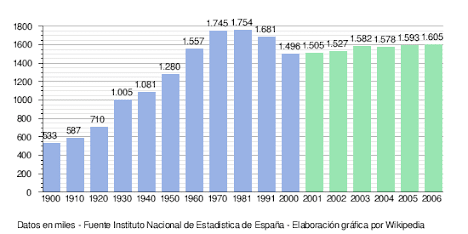
    Unfortunately for opposition parties of a Christian bent fighting the regional elections in November, the increasing presence of ex-wild beasts in Barcelona has been accompanied by a slight rise, rather than a dramatic fall, in population:

    The doleful creatures, satyrs, and dragons in pleasant palaces might be considered a fair reflection of Mayors Hereu and Clos’ troubled reign, were this problem not common to many Western cities. In a piece in the FT during the great London fox hoohaa in June Frederick Studemann issued a bold call for the introduction of urban hunts, on foot if need be:

    For the Conservative-Liberal Democrat coalition, the urban hunt would be a vehicle for the localism, the grass-roots engagement, that both parties are so keen to animate. The rallying call of the Streatham Chase, the Peckham Ryde or the Ham & High Quorn would draw on long-buried local loyalties, revealing the pull of the ancient underlying villages that define London.

    Neighbourhood rivalry would soon turn the hunts into colourful and profitable civic pageants similar to Sienna’s Palio horse race. With income from hunting licences, local councils could make good some of the revenue they will lose as Mr Cameron cuts their budgets.

    That’s probably even less likely to happen in Barcelona than repeal of the selective ban on bull-fighting, but there is precedent, and in this particular location: I read somewhere ages ago (sorry, ref) that following a wolf-hunt on Collserola in 1879 a wolf took refuge in the chapel which stood next to the old Convent of the Josepets before the construction of Avenida de la República Argentina and Plaza Lesseps. The locals found it there, and ignoring the Carmelite tradition of peace and quiet, beat it to death and then put it on public display with an entry price of eight and a half quarters. The good thing about piglets is that you can take them home and eat them.