FollowTheBaldie.com

Tag: Collserola

  • Heron City, Meridiana, Barcelona to Cerdanyola on foot

    Since someone asked, here’s what I can remember. Walking time probably 2.5 hours. Your money back if you die of hunger or are eaten by wolves.

    Head to Roquetes more or less via Via Julia metro (couple of excellent bars in the pedestrian street leading up to it), walk to the top of the shantytown and then up over open ground (there are a couple of paths and staircases) to the junction of Carretera Alta de Roquetes and Carrer Lliçà (tower of Torre Baró and ugly mirador to your right).

    If you want to take a detour to the high part of the shanties of Torre Baró with a couple of interesting bars and curious folk with the occasional pig and chicken, walk about 80m down Lliçà and there’s a break in the crash barrier with a path leading through the pine forest.

    Otherwise to continue Cerdanyola-wards take the stone path that bisects Lliçà and Alta de Roquetes heading uphill. I think you then take the 2nd path on the left, which takes you in about 10 minutes up to the summit with splendid views over Barcelona and the Maresma. You then follow the ridge for about 5 minutes, passing on the right an old iron mineshaft on the right and a path back to an old research station on the summit. [Walk tour that includes this bit.]

    In a clearing with a couple of Italian stone pines a path to the right (I think it’s signposted Can Cuyas or perhaps Sta Maria de Moncada) takes you down from the ridge. You’ll pass the cemetery on your left and then I think you arrive at a bridge over the motorway with the industrial zone of Can Cuyas on your right.

    Don’t cross the bridge unless you want to go via Sta Maria, but drop down into the valley on your left with allotments and a compound containing the flock used to graze that end of the forest. Walking parallel to the motorway along a winding dirt track you get to the cemetery access road. Turn left on that and then I seem to recall a path (lots of paths) through the woods to get to Cerdanyola.

    Here’s an approximation to the first part:

    View Larger Map

  • Time to introduce urban hunting in Barcelona?

    There’s a lovely bit in Isaiah 13 describing the ruin and desolation of Babylon:

    And Babylon, the glory of kingdoms, the beauty of the Chaldees’ excellency, shall be as when God overthrew Sodom and Gomorrah.
    It shall never be inhabited, neither shall it be dwelt in from generation to generation: neither shall the Arabian pitch tent there; neither shall the shepherds make their fold there.
    But wild beasts of the desert shall lie there; and their houses shall be full of doleful creatures; and owls shall dwell there, and satyrs shall dance there.
    And the wild beasts of the islands shall cry in their desolate houses, and dragons in their pleasant palaces: and her time is near to come, and her days shall not be prolonged.

    Lieutenant James Graydon RN, George Borrow’s colleague in these parts, obviously didn’t sell enough Bibles in the vernacular, because it doesn’t seem to have occurred to witnesses of the following incursion by a sounder (not a family) of boars from this walk on the Collserola hills behind Barcelona to this Gracia walk, near Plaza Lesseps, presumably making use of the 2-mile on-the-way-to-being-a-green-corridor created by Park Güell, Monte Carmelo and the Creueta del Coll, to draw a parallel between Babylon and Barcelona:

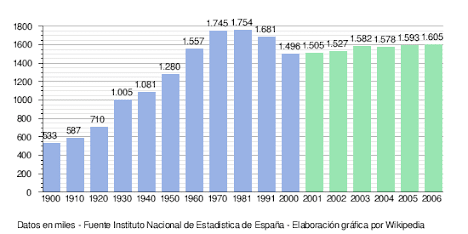
    Unfortunately for opposition parties of a Christian bent fighting the regional elections in November, the increasing presence of ex-wild beasts in Barcelona has been accompanied by a slight rise, rather than a dramatic fall, in population:

    The doleful creatures, satyrs, and dragons in pleasant palaces might be considered a fair reflection of Mayors Hereu and Clos’ troubled reign, were this problem not common to many Western cities. In a piece in the FT during the great London fox hoohaa in June Frederick Studemann issued a bold call for the introduction of urban hunts, on foot if need be:

    For the Conservative-Liberal Democrat coalition, the urban hunt would be a vehicle for the localism, the grass-roots engagement, that both parties are so keen to animate. The rallying call of the Streatham Chase, the Peckham Ryde or the Ham & High Quorn would draw on long-buried local loyalties, revealing the pull of the ancient underlying villages that define London.

    Neighbourhood rivalry would soon turn the hunts into colourful and profitable civic pageants similar to Sienna’s Palio horse race. With income from hunting licences, local councils could make good some of the revenue they will lose as Mr Cameron cuts their budgets.

    That’s probably even less likely to happen in Barcelona than repeal of the selective ban on bull-fighting, but there is precedent, and in this particular location: I read somewhere ages ago (sorry, ref) that following a wolf-hunt on Collserola in 1879 a wolf took refuge in the chapel which stood next to the old Convent of the Josepets before the construction of Avenida de la República Argentina and Plaza Lesseps. The locals found it there, and ignoring the Carmelite tradition of peace and quiet, beat it to death and then put it on public display with an entry price of eight and a half quarters. The good thing about piglets is that you can take them home and eat them.