FollowTheBaldie.com

Category: Default

  • Story of my life

    From Hansel and Gretel, a 1954 stop-motion feature based on Humperdinck’s children’s opera:

    Michael Sporn has some more on the film. The Padraic Colum writing credit has me re-arranging my mental furniture – he was in his early 70s by then, and I’m afraid if you asked me for an Irish writer contributing to late German romanticism I’d immediately start giggling at the recollection of the Flann O’Brien piss-takes in the Irish Times.

  • Discount for kiddies clarified

    They were always given, but now the walk price calculator incorporates them. Apologies for the apparently eternal wait!

  • Happy New Year!

    I suppose you could say he’s my role model.

  • Barcelona Star Wars Procession

    Seen Sunday on this Barcelona city tour. Paying people to mount ridiculous events to coincide with walks doesn’t come cheap, but it’s something we just have to do. Barcelona is full unemployable actors, and I spent ages trying to persuade various of their number that they could gain valuable paid experience dressing up as a giant tarantula and riding on a moped at three in the morning over forest tracks to a ruined farmhouse to lie in wait for participants in Night of the Tarantula. But they were having none of it.

  • Barcelona bike rentals – comparative chart

    Since folks started offering bicycle tours and rentals to tourists a few years back, quite a lot of businesses have come onto the market and there’s been something of a price war. So I thought it would be interesting to compile a brief guide to who charges what. Barceloneta Bikes almost always make good on their “best hire rates in the city,” although I have no idea what kind of bikes they use. I’m a big fan of Classic Bikes‘ mid-priced models. And given their prices My Beautiful Parking must be doing something else that is really special to get any business at all. Some of them are vague on opening hours, and a couple on whether a day means 24 hours or not. Anyway, here you are.

  • The Spanish General Strike

    This reiterates part of the information already sent to clients.

    None of us will be seconding the general strike announced by the two largest union federations for Wednesday. We believe with varying degrees of ferocity that slowing labour reform, while conceivably benefiting an elderly class of hyper-protected functionaries and trade union officials, would damage even further the economic prospects of the two groups worst hit by the crisis – immigrants and young people, into both of which categories most of us fall.

    Those of us who regard ourselves as syndicalists in some sense also reject the strike because we believe it suicidal to the cause of trade unionism in this country. The government is inhibited by markets and by Brussels from changing course, and any sign that it were about to do so would cause further economic destruction for people like us, although perhaps not for the people who have called the strike. There is nothing to be gained by it.

  • Time to introduce urban hunting in Barcelona?

    There’s a lovely bit in Isaiah 13 describing the ruin and desolation of Babylon:

    And Babylon, the glory of kingdoms, the beauty of the Chaldees’ excellency, shall be as when God overthrew Sodom and Gomorrah.
    It shall never be inhabited, neither shall it be dwelt in from generation to generation: neither shall the Arabian pitch tent there; neither shall the shepherds make their fold there.
    But wild beasts of the desert shall lie there; and their houses shall be full of doleful creatures; and owls shall dwell there, and satyrs shall dance there.
    And the wild beasts of the islands shall cry in their desolate houses, and dragons in their pleasant palaces: and her time is near to come, and her days shall not be prolonged.

    Lieutenant James Graydon RN, George Borrow’s colleague in these parts, obviously didn’t sell enough Bibles in the vernacular, because it doesn’t seem to have occurred to witnesses of the following incursion by a sounder (not a family) of boars from this walk on the Collserola hills behind Barcelona to this Gracia walk, near Plaza Lesseps, presumably making use of the 2-mile on-the-way-to-being-a-green-corridor created by Park Güell, Monte Carmelo and the Creueta del Coll, to draw a parallel between Babylon and Barcelona:

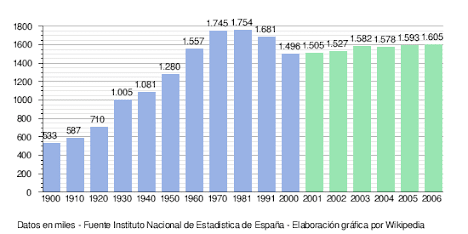
    Unfortunately for opposition parties of a Christian bent fighting the regional elections in November, the increasing presence of ex-wild beasts in Barcelona has been accompanied by a slight rise, rather than a dramatic fall, in population:

    The doleful creatures, satyrs, and dragons in pleasant palaces might be considered a fair reflection of Mayors Hereu and Clos’ troubled reign, were this problem not common to many Western cities. In a piece in the FT during the great London fox hoohaa in June Frederick Studemann issued a bold call for the introduction of urban hunts, on foot if need be:

    For the Conservative-Liberal Democrat coalition, the urban hunt would be a vehicle for the localism, the grass-roots engagement, that both parties are so keen to animate. The rallying call of the Streatham Chase, the Peckham Ryde or the Ham & High Quorn would draw on long-buried local loyalties, revealing the pull of the ancient underlying villages that define London.

    Neighbourhood rivalry would soon turn the hunts into colourful and profitable civic pageants similar to Sienna’s Palio horse race. With income from hunting licences, local councils could make good some of the revenue they will lose as Mr Cameron cuts their budgets.

    That’s probably even less likely to happen in Barcelona than repeal of the selective ban on bull-fighting, but there is precedent, and in this particular location: I read somewhere ages ago (sorry, ref) that following a wolf-hunt on Collserola in 1879 a wolf took refuge in the chapel which stood next to the old Convent of the Josepets before the construction of Avenida de la República Argentina and Plaza Lesseps. The locals found it there, and ignoring the Carmelite tradition of peace and quiet, beat it to death and then put it on public display with an entry price of eight and a half quarters. The good thing about piglets is that you can take them home and eat them.

  • A Cantabrian brown bear encounter in the Valley of Aguayo

    In the previous post I named two of the problems facing rural walkers in Spain as a lack of refreshments and motorway building. Judging by the numbers of young horses and cattle loose on the slopes of Otero running down into the Embalse de Alsa near San Miguel de Aguayo in Cantabria, the first problem is unlikely to affect the brown bear we heard roaring early on the morning of July 24th in the beech forest between the summit of Otero and Vallejo Rucándano. The second however will surely have an impact: as the map over at Aves del norte de Burgos shows, the AP-69 Dos Mares motorway will tear right through the middle of this zone, just as soon as government funds are available for its construction.

    I’ve lived quite a lot of my life in the countryside, and spent some formative years in the vicinity of a brutally-run slaughterhouse, so I’m quite certain that the sound that chilled our bones wasn’t that of an injured cow or enraged bull, and anyone else who has heard bears before will confirm that it is not something one easily forgets. Nevertheless, I did at first question my ears, because Cantabrian brown bears very rarely make it this far east–the map over at Fundación Oso Pardo shows an eastern population of 30 bears concentrated in eastern León and western Palencia, with offshoots in Campoo de Suso and Liébana. Recent sightings of another bear in Valderredible on the Ebro on the other side of the reservoir may suggest the beginnings of an eastward trend.

    One of the interesting things about the article is its propagation of the myth of conflict-free human-bear coexistence. This seems to me to be driven by often cuddly-animal ecologist and rural tourism propaganda (the FOP does a pretty good job, however), and it ignores the evidence from for example Eastern Europe, the Balkans and Asia Minor. Jerina et al, Modeling the brown bear population in Slovenia, report similar naivety during the early phase of bear management there, and other papers (eg Ambarlı & Bilgin Human–brown bear conflicts in Artvin, northeastern Turkey) report considerable resentment by unprepared farmers and villagers of bear attacks on livestock, beehives and orchards, as well as a slow trickle of fatal attacks on humans by brown bears. This doesn’t perhaps justify the killing of brown bears in for example the Pyrenees by farmers as well as hunters, but it does help explain it and why it is unlikely to disappear.

    The potential for bears encountering humans is currently pretty small–the countryside is generally empty, and humans rarely leave the protection of cars or buildings, and bears don’t seem to have taken to dumpster diving to the same extent as in Canada–but pre-20th century Spanish literature provides the occasional glimpse of ursine terror. My favourite is in the late-15th century Las sergas de Esplandián by Garci Rodríguez de Montalvo, which, except for Maneli’s subsequent miraculous recovery, provides a pretty good account of a bear attack:

    Mucho placer hubieron aquellos caballeros en se ver, por cualquier manera que fuesen, salidos en tierra; y como la barca á la orilla llegase, salieron fuera, y atándola por la cadena á un árbol, dejando en ella el uno de sus escuderos, acordaron de saber qué remedio allí se hallaría; y comenzaron de entrar por la isla, llevando los yelmos en sus cabezas y los escudos á los cuellos. Mas no anduvieron mucho, que en un valle hallaron una fuente debajo de unos altos y hermosos árboles, donde quitados sus yelmos, se lavaron y bebieron del agua, que dulce y sabrosa les pareció. El escudero que con ellos iba, que era del rey de Dacia, que Argento se llamaba, les dijo: «Buenos señores, yo, que vengo sin armas, si lo tenéis por bien, quiero saber qué hay en esta isla, porque, según lo que hallare, así tomaréis el acuerdo. — Bien será, dijeron ellos, pero sea de manera que no vos perdamos. — Asi lo haré, dijo él, que si desde aquella cumbre no viere lo que busco, tornarme he para vosotros.» Entonces se fué por entre las matas, y siendo una pieza dellos alejado, vido contra si venir un oso muy grande á maravilla, de que hubo gran temor; y dando muy grandes voces que lo socorriesen, se subió muy presto en un árbol; mas el oso lo siguió hasta ser al pié del árbol. Los caballeros, que á la fuente quedaron, como las voces de Argento oyeron, fueron á mas correr hácia allá, con tanta priesa, que los yelmos no pudieron tomar, y se quedaron cabe la fuente; y llegando al escudero, viéronle estar en el árbol, y el oso que subía por lo tomar; mas ellos dieron muy grandes voces porque lo dejase, á las cuales el oso volviendo el rostro, vido los caballeros que contra él iban, descendió cuanto mas pudo, y se volvió para ellos levantado en los piés traseros. Maneli, como ríe mas edad y mas recio que el Rey fuese, iba delante, poniendo el escudo encima de la cabeza, y la espada en la mano fué para él, y dióle un gran golpe en la cabeza, que le derribó la una oreja con parte de las quijadas; mas el oso le tomó entre sus fuertes brazos y trabo con los dientes en el escudo tan fuertemente, que todos pasaron de la otra parte; así que, Maneli fue tan embarazado de los brazos, del oso que consigo apretado le tenia, que no se pudo valer ni hacer mas, y parecióle que todos los huesos del cuerpo le quebraban. Mas á esta hora llegó el rey de Dacia, y hirió con su espada al oso en el un brazo de tal golpe, que se lo cortó todo á cercen, junto á la mano, de manera que luego cayó en tierra. El oso dió un gran bramido, y soltando el caballero, comenzó de huir en tres piés, y el Rey en pos dél corriendo por lo herir; y no lo pudiendo alcanzar, tornóse donde Maneli estaba asaz quebrantado de la batalla del oso; y como llegó á él, preguntóle cómo le iba. «Mal me va, dijo él; que aquella mala bestia endiablada me ha quebrantado todo mi cuerpo.»

    The bear might have got him anyway, but Wikipedia explains one basic error in Maneli’s approach:

    Running away or climbing a tree can activate the bear’s hunting instincts and lead to it perceiving the human as prey. If a bear does charge, persons are advised to hold their ground, as most bear charges are bluffs. Finally, if a bear does attack, the usual advice is to curl into a fetal position so as to shield vital organs and appear non-threatening. If this is not effective in stopping the attack, the only option left is to fight the bear in any way you can.

    The adventures of Esplandián is a work of chivalry, so it doesn’t mention that the best defence is to travel with a slower-moving companion.
  • Eating and accommodation tips for GR99, GR85, GR73

    I’ve been ordered to be more sociable with information which isn’t of much use to me but may be to others. So ***here*** for starters are ratings for various bars, restaurants, casas rurales, bed and breakfasts and hotels on the GR-99, GR-85, and the GR-73, passing through Logroño, Baños de Sobrón, San Martín de Don, Barcina del Barco, Montejo de San Miguel, Trespaderne, Puente Arenas, Hoz de Valdivielso, Puente Arenas, Valdenoceda, Peñalba de Manzanedo, Cidad de Ebro, Cilleruelo, La Población de Yuso, Soncillo, La Población de Yuso, Silió, Molledo, Ventorillo, Pesquera, Las Fraguas, Caldas de Besaya, Viveda, Torrelavega and Santander in the provinces of La Rioja, Burgos and Cantabria. I’ve included all the stuff for which I have notes, but there are omissions. Contact me if you have any queries.

    As you’ll see and may already be aware, the extraordinary growth in the casa rural sector over the past few years has given rise to some marvellous establishments (see eg La Behetria in Peñalba de Manzanedo) but also to a considerable number of enterprises which are poorly run and considerably more expensive than hotels of a comparable standard. Hopefully the market will take care of this over the next few years.

    A second, graver problem for long-distance walkers in sparsely populated areas throughout Spain (and Europe) is the increasing lack of bars and shops. There is only so much that one wants or is able to carry, and casa-rural-type facilities are frequently unwilling or unable to sell food at competitive prices. This is all despite the fact that many villages contain small but active populations of pensioners and rural hippies with flourishing allotments and freezers full from weekly trips to urban supermarkets.

    As far as I can see the only sensible solution is radical deregulation of rural eating, drinking and shopping, removing the completely useless 90% of rules created by autonomous communities during democracy. These imitations of the fascist control-freakery of Manuel Fraga make it impossible to (re)sell produce at farm gates or offer lunches or snacks to passersby on a casual basis and the only beneficiaries appear to be the inspectors, who come and eat their free lunch every now and again and then vanish. For such regulation might conceivably have made sense in the information-poor 1960s, but it is surely redundant now we have reasonably effective online consumer forums and more efficient instruments for punishing grievous offenders.

    One thing of which you should be aware if you plan on following either the GR-99, the GR-85, or the GR-73 is the extent to which the countryside has been ruined by motorway construction. Motorway noise impacts considerably on the GR-73 for much of its course, and I found its proximity fairly unpleasant north of Molledo until Santillana. The GR-99 and GR-85 will be similarly affected by the construction of the autopista AP-69 Dos Mares, which as you can see from the map over at Aves del norte de Burgos closely follows the course of the GR-99 and will utterly destroy the sensitive and quite extraordinarily beautiful valley of the Aguayos, of which more some other time. Still, I suppose any remaining walkers will be able to pop into service stations every 50km or so.

  • 10% off all prices this summer

    In recognition of the problems we’re all facing this year, we’re offering 10% off all prices for Barcelona walking tours and tours in other locations until the end of September. You’ll see the reduction when you request price quotes on each walk page.

    This wouldn’t be happening if Spain wasn’t in the euro…

    Have a good summer!